Wildfire Ember Transport Modeling
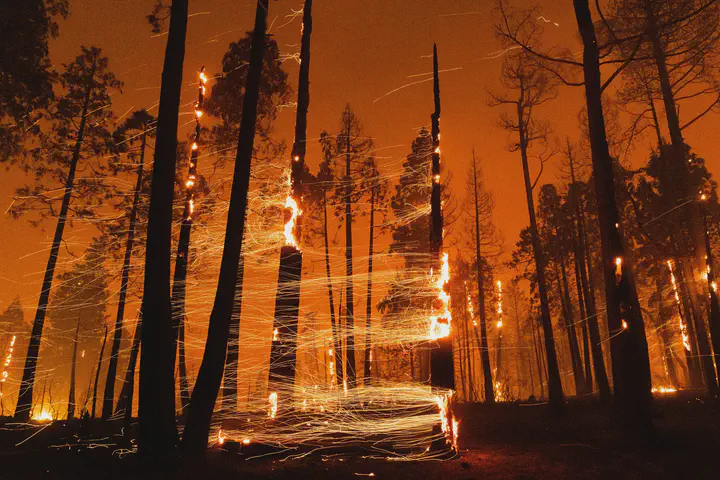 Photo by Max Whittaker on NY Times
Overview
This project is about the numerical modeling of firebrand showers in wildfire simulations.
Problem: Firebrands can spread wildfire through the ignition of spot fires, yet there is a gap in knowledge on where they will land due to turbulent wind
Solution: Model high-resolution turbulent boundary layers at various turbulence intensities, and release firebrands in those domains to study the effect of small-scale turbulence
Results: Novel implementation of firebrand transport model coupled with wildfire simulation WRF-SFIRE for comparison between large-scale and small-scale transport
Problem
Firebrand showers are the fastest and most complex form of wildfire spread, by generating spot fires in random locations.
There is a gap in knowledge on where firebrands land due to turbulent wind.
There is no existing coupled firebrand-wildfire simulation with complex firebrand shapes.
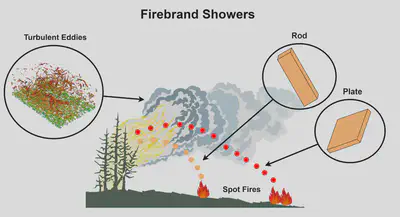
Firebrand shapes
Experimental data has shown that firebrands are made of 3 basic shapes: compact, plate, and rod. Studies have shown that particles of different shapes have different flight trajectories. And in the wildfire research community, these difference have not yet been fully explored.
Small & Large-scale Turbulence
Modern wildfire simulations use large grid sizes in their computational meshes (around 250-300 m). This leads to only large-scale turbulence seen in the flow. Understanding the transport of plate and rod shapes in small-scale turbulence is crucial for understanding large-scale transport in wildfire simulations. With this knowledge, researchers will better understand how spot fires are generated.
Turbulent Boundary Layers
Setup
| Parameters | Mesh Resolution | Simulation Cases |
|---|---|---|
| U = 2.23 m/s | ∆x = 0.025 m | 4% turbulence intensity |
| Re = 284,000 | ∆y = 0.025 m | 7% turbulence intensity |
| L = 2 m | ∆z = 0.025 m | |
| 𝓥 = 1.568E-5 |
Validation
Velocity profile of turbulent boundary layer simulations was validated with experimental data from Tohidi 2016. Power spectral density of turbulent boundary layer simulations validated with Kolomorgov -5/3 Spectrum to show a fully developed flow.
Results
Q-Criterion Iso-surfaces of the vortices in the 4% turbulence intensity simulation case
Firebrand Transport Simulations
Small-scale Transport
A series of 32 tests were conducted in the high-resolution turbulent boundary layer simulations in uniform and turbulent velocity fields. Plates and rods were released at 4 different heights

Antonio Cervantes
Ph.D. Student in Civil and Environmental Engineering
My research interests are in wildfires, particle transport, and turbulence